Comparison
DeepSeek vs GLM
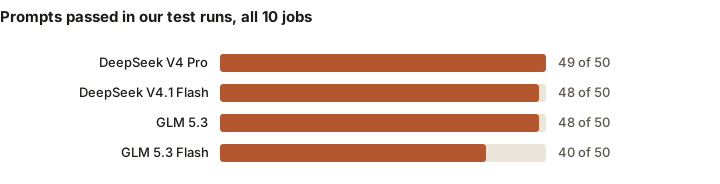
In our test runs on October 8, 2026, the same 50 prompts across 10 jobs: DeepSeek's 2 models passed 97 of 100 replies and GLM's 2 models passed 88 of 100 replies. On llmwise Pro, DeepSeek V4 Pro up to 250 messages a month and GLM 5.3 up to 250.
Based on 200 of our test runs on , through OpenRouter with the app's own prompt and settings. Updated .
Short answer
Job by job, both families' best models shared the top result on 7 of the 10 jobs; DeepSeek's alone had it on writing and summarization; GLM's alone had it on customer support.
DeepSeek vs GLM, job by job
On each job, DeepSeek's pick against GLM's: the model of each family that passed the most of the job's 5 prompts (then the most hard ones, then the cheaper). The jobs where they differ most come first.
Writing: DeepSeek V4 Pro passed 5 of 5 and GLM 5.3 4 of 5. GLM 5.3 answered 2.2× sooner at the median, 3.9 s against 1.8 s. GLM 5.3 cost 1.9× less, $0.0054 against $0.0029 for the 5 replies. GLM 5.3's replies ran 29% longer, in tokens of reply, thinking not counted.
Summarization: DeepSeek V4.1 Flash passed 5 of 5 and GLM 5.3 4 of 5. DeepSeek V4.1 Flash answered 2.1× sooner at the median, 0.5 s against 1.1 s. DeepSeek V4.1 Flash cost 2.7× less, $0.0010 against $0.0027 for the 5 replies. Their replies ran to about the same length.
Customer support: DeepSeek V4 Pro passed 4 of 5 and GLM 5.3 5 of 5. GLM 5.3 answered 1.8× sooner at the median, 4.1 s against 2.3 s. GLM 5.3 cost 3.3× less, $0.0077 against $0.0023 for the 5 replies. GLM 5.3's replies ran 22% longer, in tokens of reply, thinking not counted.
Coding: DeepSeek V4.1 Flash passed 5 of 5 and GLM 5.3 Flash 5 of 5. DeepSeek V4.1 Flash answered 3.4× sooner at the median, 2.5 s against 8.4 s. GLM 5.3 Flash cost 7.3× less, $0.0092 against $0.0013 for the 5 replies. DeepSeek V4.1 Flash's replies ran 47% longer, in tokens of reply, thinking not counted.
Math: DeepSeek V4.1 Flash passed 5 of 5 and GLM 5.3 Flash 5 of 5. DeepSeek V4.1 Flash answered 2.9× sooner at the median, 0.9 s against 2.7 s. GLM 5.3 Flash cost 1.7× less, $0.0012 against $0.0008 for the 5 replies. Their replies ran to about the same length.
Data analysis: DeepSeek V4.1 Flash passed 5 of 5 and GLM 5.3 5 of 5. DeepSeek V4.1 Flash answered 2.2× sooner at the median, 0.9 s against 1.9 s. DeepSeek V4.1 Flash cost 2.3× less, $0.0042 against $0.0096 for the 5 replies. Their replies ran to about the same length.
Translation: DeepSeek V4.1 Flash passed 5 of 5 and GLM 5.3 Flash 5 of 5. DeepSeek V4.1 Flash answered 3.0× sooner at the median, 1.3 s against 4.1 s. GLM 5.3 Flash cost 5.9× less, $0.0029 against $0.0005 for the 5 replies. DeepSeek V4.1 Flash's replies ran 44% longer, in tokens of reply, thinking not counted.
SQL: DeepSeek V4.1 Flash passed 5 of 5 and GLM 5.3 Flash 5 of 5. DeepSeek V4.1 Flash answered 3.5× sooner at the median, 0.4 s against 1.4 s. GLM 5.3 Flash cost 1.6× less, $0.0010 against $0.0006 for the 5 replies. Their replies ran to about the same length.
RAG and answering from documents: DeepSeek V4.1 Flash passed 5 of 5 and GLM 5.3 Flash 5 of 5. DeepSeek V4.1 Flash answered 6.6× sooner at the median, 0.3 s against 2.2 s. They cost about the same, $0.0008 against $0.0008 for the 5 replies. DeepSeek V4.1 Flash's replies ran 16% longer, in tokens of reply, thinking not counted.
Agents and tool use: DeepSeek V4.1 Flash passed 5 of 5 and GLM 5.3 5 of 5. DeepSeek V4.1 Flash answered 2.5× sooner at the median, 0.4 s against 0.9 s. DeepSeek V4.1 Flash cost 2.2× less, $0.0010 against $0.0022 for the 5 replies. DeepSeek V4.1 Flash's replies ran 13% longer, in tokens of reply, thinking not counted.
The 3 prompts only one of DeepSeek and GLM passed
Where one family's pick passed a prompt and the other's didn't, in each check's own words.
Argue both sides of free buses (writing): DeepSeek V4 Pro passed and GLM 5.3 didn't. DeepSeek V4 Pro: Graded 4.7 of 5 on average (lowest 4). GLM 5.3: Graded 3.7 of 5 on average (lowest 3); but a paragraph of 92 words, over the 90 allowed.
An article in three bullets (summarization): DeepSeek V4.1 Flash passed and GLM 5.3 didn't. DeepSeek V4.1 Flash: Graded 4.7 of 5 on average (lowest 4). GLM 5.3: Graded 4.3 of 5 on average (lowest 3); but 68 words, over the 60 allowed.
A frustrated customer (customer support): GLM 5.3 passed and DeepSeek V4 Pro didn't. DeepSeek V4 Pro: Graded 2.3 of 5 on average (lowest 1). GLM 5.3: Graded 4.7 of 5 on average (lowest 4).
Each DeepSeek model against each GLM model
Every DeepSeek model against every GLM model on the same 50 prompts: each one's passes, how many prompts split them, and who was cheaper and quicker.
DeepSeek V4 Pro vs GLM 5.3: 49 and 48 of 50; 3 prompts split them; GLM 5.3's replies cost 5.0× less in all, and GLM 5.3 answered sooner on 45, DeepSeek V4 Pro on 3. DeepSeek V4 Pro vs GLM 5.3.
DeepSeek V4 Pro vs GLM 5.3 Flash: 49 and 40 of 50; 9 prompts split them; GLM 5.3 Flash's replies cost 19.0× less in all, and DeepSeek V4 Pro answered sooner on 27, GLM 5.3 Flash on 19. DeepSeek V4 Pro vs GLM 5.3 Flash.
DeepSeek V4.1 Flash vs GLM 5.3: 48 and 48 of 50; 4 prompts split them; DeepSeek V4.1 Flash's replies cost 1.4× less in all, and DeepSeek V4.1 Flash answered sooner on 36, GLM 5.3 on 10. DeepSeek V4.1 Flash vs GLM 5.3.
DeepSeek V4.1 Flash vs GLM 5.3 Flash: 48 and 40 of 50; 10 prompts split them; GLM 5.3 Flash's replies cost 2.7× less in all, and DeepSeek V4.1 Flash answered sooner on 46, GLM 5.3 Flash on 2. DeepSeek V4.1 Flash vs GLM 5.3 Flash.
One writing prompt, both replies
DeepSeek V4 Pro and GLM 5.3 on a writing prompt, the job where they differed most: both replies as they came.
A hard prompt: “Argue both sides of free buses”, in full.
DeepSeek V4 Pro
Passed: Graded 4.7 of 5 on average (lowest 4).
Making buses free turns public transit into a true public good, like sidewalks or libraries. It removes fares as a barrier for low-income riders, boosts ridership, cuts traffic congestion and emissions, and speeds boarding by eliminating payment delays. Cities already subsidize most transit costs; dropping the small fare share is a modest investment with outsized returns in mobility, equity, and cleaner air.

The strongest case against free buses is that fares, however small, are the only direct signal of demand. Removing them invites overcrowding on popular routes while doing nothing to expand service where it is sparse. Scarce transit dollars are better spent on frequency, reliability, and coverage—improvements that actually attract riders—than on subsidizing trips for people who can already afford to pay.
395 tokens in, 193 out (40 of them reasoning) · 4.1 s · $0.0009 · 1 message on Pro · answered by deepseek/deepseek-v4-pro-0813 via Wafer ·
GLM 5.3
Failed: Graded 3.7 of 5 on average (lowest 3); but a paragraph of 92 words, over the 90 allowed.
A city should make its buses free because the benefits ripple far beyond riders. Fare-free transit boosts ridership immediately, cutting car trips, congestion, and emissions while improving air quality. It saves low-income residents money, connects workers to jobs, students to schools, and seniors to care, and it eliminates fare enforcement disputes that disproportionately harm marginalized riders. Fares often recover only a modest share of operating costs anyway, so removing them trades a small revenue stream for a faster, fairer, more accessible city — a genuine public good like roads and libraries.

Yet free buses carry real costs that advocates understate. Fare revenue funds service; eliminate it and the burden shifts to taxpayers, many of whom never ride, straining budgets already stretched thin. Free buses can overload the system — especially with vulnerable riders seeking shelter — degrading the experience for commuters who depend on reliability. Fare-free transit can also reduce pressure to improve service quality, since riders are no longer paying customers with leverage. And studies suggest it mainly attracts walkers and cyclists, not drivers, doing little for climate. There's no free lunch: someone pays.
422 tokens in, 234 out (11 of them reasoning) · 1.8 s · $0.0013 · 1 message on Pro · answered by z-ai/glm-5.3 via Wafer ·
Every model, every job
All 4 DeepSeek and GLM models in llmwise across the 50 prompts, with what a reply cost to run and each model's count on Pro.
| Model | Passed | Hard ones | Cost per reply | On Pro |
|---|---|---|---|---|
| DeepSeek V4 ProDeepSeek | 49 of 50 | 20 of 20 | $0.0037 | Up to 250 a month |
| DeepSeek V4.1 FlashDeepSeek | 48 of 50 | 19 of 20 | $0.00052 | Up to 60 a day |
| GLM 5.3Z.ai | 48 of 50 | 19 of 20 | $0.00073 | Up to 250 a month |
| GLM 5.3 FlashZ.ai | 40 of 50 | 16 of 20 | $0.00019 | Up to 60 a day |
Passed: replies that passed their check, of those scored. Cost: what OpenRouter charged us per reply, on average; in llmwise you pay per message, not per token. Every prompt and how it's scored.
Every limit is published. Paid plans also have a monthly fair-use limit on AI cost: Plus $3.75, Pro $7.50, Max $20, Ultra $42, Studio $85. Using every message on your plan at typical sizes stays under it; very large messages and heavy research use it faster. Every limit, explained.
The lineups at a glance
What follows from each model's facts in our catalog.
The lineups
DeepSeek: 2 models, DeepSeek V4 Pro and DeepSeek V4.1 Flash. GLM: 2 models, GLM 5.3 and GLM 5.3 Flash.
Price per message
The least expensive DeepSeek model is DeepSeek V4.1 Flash (60 messages a day on Pro); the least expensive GLM model is GLM 5.3 Flash (60 messages a day on Pro).
Context window
Both go up to 1.05M tokens of context (DeepSeek V4 Pro and GLM 5.3).
Images and PDFs
DeepSeek V4 Pro and GLM 5.3 don't read images. DeepSeek V4 Pro, DeepSeek V4.1 Flash, GLM 5.3, and GLM 5.3 Flash get a PDF's text rather than the file itself.
On the Free plan
None of these models is on the Free plan. Paid plans have them all, with messages every month.
Model by model
Two named models side by side, prompt by prompt, each with its messages on every plan.
More head-to-heads
Each of DeepSeek and GLM against the other families, every job from the same test runs.
Where your messages go
DeepSeek and GLM models are served only through OpenRouter, by endpoints that don't store or train on prompts. The Privacy Policy has the details.
Questions
Which is better, DeepSeek or GLM?
In our test runs on October 8, 2026, the same 50 prompts across 10 jobs: DeepSeek's 2 models passed 97 of 100 replies and GLM's 2 models passed 88 of 100 replies. Job by job, both families' best models shared the top result on 7 of the 10 jobs; DeepSeek's alone had it on writing and summarization; GLM's alone had it on customer support.
Which is cheaper, DeepSeek or GLM?
In llmwise, the least expensive DeepSeek model is DeepSeek V4.1 Flash (60 messages a day on Pro), and the least expensive GLM model is GLM 5.3 Flash (60 messages a day on Pro). At API list prices (October 2026), a typical message of 4,000 tokens in and 700 out costs $0.0020 on DeepSeek V4.1 Flash and $0.0010 on GLM 5.3 Flash.
Can I use DeepSeek and GLM in the same chat?
Yes. Pick a model for each message; when you switch, the next model sees the whole conversation, including the other one's answers.
Claude, GPT, Gemini, DeepSeek, Grok, Kimi, GLM, and Mistral, in one chat.
See what a message costs before you send it. Free is 5 messages to try; sign in with an email link, no password or card.