Comparison · Math
ChatGPT vs Grok for math
On llmwise Pro, GPT-6.1 Sol gets up to 125 messages a month and Grok 4.7 up to 250 messages a month. ChatGPT is OpenAI's own app for its GPT models; llmwise has GPT models in its own chat, not ChatGPT itself. We ran the same 5 math prompts on all 4 GPT models and Grok's one model and published every reply: the results, then GPT-6.1 Sol against Grok 4.7 prompt by prompt, then how GPT and Grok compare on price per message, context and files.
Based on 25 of our test runs on , through OpenRouter with the app's own prompt and settings. Updated .
Short answer
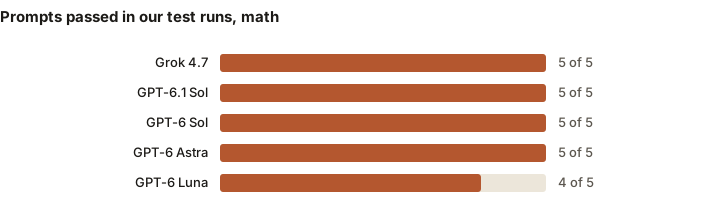
In our math test runs on October 2, 2026, GPT's 4 models passed 19 of 20; GPT-6 Astra, GPT-6.1 Sol, and GPT-6 Sol each passed 5 of 5. Grok's one model passed 5 of 5 ($0.0072 a reply). GPT-6.1 Sol and Grok 4.7 each passed 5 of the 5 prompts, so these math prompts don't split GPT and Grok; the replies on this page show how they differ.
GPT and Grok on our math test runs
Every GPT and Grok model in llmwise on our 5 math prompts: how many replies passed, what each counted as on Pro, and what it cost to run.
| Model | Passed | Hard ones | Messages used on Pro | Cost per reply | Time per reply |
|---|---|---|---|---|---|
| GPT-6 AstraOpenAI | 5 of 5 | 2 of 2 | 1 each, of 31 a month on Pro | $0.0085 | 2.7 s |
| GPT-6.1 SolOpenAI | 5 of 5 | 2 of 2 | 1 each, of 125 a month on Pro | $0.0009 | 2.0 s |
| GPT-6 SolOpenAI | 5 of 5 | 2 of 2 | 1 each, of 125 a month on Pro | $0.0018 | 2.2 s |
| GPT-6 LunaOpenAI | 4 of 5 | 2 of 2 | 1 each, of 60 a day on Pro | $0.0001 | 2.4 s |
| Grok 4.7xAI | 5 of 5 | 2 of 2 | 1 each, of 250 a month on Pro | $0.0072 | 11.6 s |
Every limit is published. Paid plans also have a monthly fair-use limit on AI cost: Plus $3.75, Pro $7.50, Max $20, Ultra $42, Studio $85. Using every message on your plan at typical sizes stays under it; very large messages and heavy research use it faster. Every limit, explained.
GPT vs Grok, prompt by prompt
Each math prompt with GPT-6.1 Sol and Grok 4.7 side by side, as they replied: for each side, the model that passed the most math prompts (then the most hard ones, then the cheaper).
Math: GPT-6.1 Sol passed 5 of 5 and Grok 4.7 5 of 5. GPT-6.1 Sol answered 6.6× sooner at the median, 1.8 s against 11.7 s. GPT-6.1 Sol cost 8.4× less, $0.0043 against $0.0362 for the 5 replies. Grok 4.7's replies ran 67% longer, in tokens of reply, thinking not counted.
1. A discount, then sales tax
Everyday. GPT: 4 of 4 models passed, GPT-6 Luna the cheapest at $0.0001 · Grok: 1 of 1 model passed, Grok 4.7 at $0.0033. The prompt in full.
GPT-6.1 Sol and Grok 4.7 both passed this one. GPT-6.1 Sol answered sooner (1.5 s to 4.8 s), and GPT-6.1 Sol's reply cost less ($0.0006 to $0.0033); GPT-6.1 Sol wrote 39 tokens of reply, Grok 4.7 65.
GPT-6.1 Sol
Passed: Final answer 66: right.
Discounted price: $80 × 0.75 = $60
After sales tax: $60 × 1.10 = $66

Final answer: $66
402 tokens in, 39 out · 1.5 s · $0.0006 · 1 message on Pro · answered by openai/gpt-6.1-sol via OpenAI ·
Grok 4.7
Passed: Final answer 66: right.
Discount: \(80 \times 0.25 = 20\), so sale price is \(80 - 20 = 60\).
Tax: \(60 \times 0.10 = 6\), so final price is \(60 + 6 = 66\).

Final answer: $66
1,635 tokens in, 290 out (225 of them reasoning) · 4.8 s · $0.0033 · 1 message on Pro · answered by x-ai/grok-4.7 via xAI ·
2. Pens at 3 for $4
Everyday. GPT: 3 of 4 models passed, GPT-6.1 Sol the cheapest at $0.0010 · Grok: 1 of 1 model passed, Grok 4.7 at $0.0111. The prompt in full.
GPT-6.1 Sol and Grok 4.7 both passed this one. GPT-6.1 Sol answered sooner (2.4 s to 18.5 s), and GPT-6.1 Sol's reply cost less ($0.0010 to $0.0111); GPT-6.1 Sol wrote 89 tokens of reply, Grok 4.7 211.
GPT-6.1 Sol
Passed: Final answer Buy three 3-pen bundles and one single pen for 13.50.: right.
Three singles cost $4.50, so each 3-for-$4 bundle saves $0.50. Use as many bundles as possible: 3 bundles give 9 pens, then buy 1 single.

Cost: \(3 \times \$4 + \$1.50 = \$13.50\).

Final answer: Buy three 3-pen bundles and one single pen for $13.50.
404 tokens in, 127 out (38 of them reasoning) · 2.4 s · $0.0010 · 1 message on Pro · answered by openai/gpt-6.1-sol via OpenAI ·
Grok 4.7
Passed: Final answer 3 packs + 1 single ( 13.50): right.
To buy exactly 10 pens, let \(x\) be the number of 3-packs (at \$4 each) and \(y\) the number of singles (at \$1.50 each), so \(3x + y = 10\) with \(x, y\) non-negative integers. The cost is \(4x + 1.5y\).

Feasible options:
- \(x=0\), \(y=10\): \$15.00
- \(x=1\), \(y=7\): \$14.50
- \(x=2\), \(y=4\): \$14.00
- \(x=3\), \(y=1\): \$13.50

Packs are cheaper per pen than singles, so maximizing packs (without exceeding 10) is optimal. Buying 4 packs yields 12 pens for \$16, which both exceeds 10 and costs more.

Final answer: 3 packs + 1 single ($13.50)
1,637 tokens in, 1,596 out (1,385 of them reasoning) · 18.5 s · $0.0111 · 1 message on Pro · answered by x-ai/grok-4.7 via xAI ·
3. Compound interest over three years
Everyday. GPT: 4 of 4 models passed, GPT-6 Luna the cheapest at $0.0001 · Grok: 1 of 1 model passed, Grok 4.7 at $0.0051. The prompt in full.
GPT-6.1 Sol and Grok 4.7 both passed this one. GPT-6.1 Sol answered sooner (1.7 s to 8.0 s), and GPT-6.1 Sol's reply cost less ($0.0007 to $0.0051); GPT-6.1 Sol wrote 64 tokens of reply, Grok 4.7 65.
GPT-6.1 Sol
Passed: Final answer 315.25: right.
After 3 years, the balance is:
\[
2000(1.05)^3 = \$2,315.25
\]

Interest earned:
\[
\$2,315.25 - \$2,000 = \$315.25
\]

Final answer: $315.25
404 tokens in, 64 out · 1.7 s · $0.0007 · 1 message on Pro · answered by openai/gpt-6.1-sol via OpenAI ·
Grok 4.7
Passed: Final answer 315.25: right.
The balance after 3 years is \(2000 \times (1.05)^3 = 2000 \times 1.157625 = 2315.25\).

Interest earned is \(2315.25 - 2000 = 315.25\).

Final answer: 315.25
1,637 tokens in, 649 out (584 of them reasoning) · 8.0 s · $0.0051 · 1 message on Pro · answered by x-ai/grok-4.7 via xAI ·
4. Four-digit numbers whose digits sum to 9
Hard. GPT: 4 of 4 models passed, GPT-6 Luna the cheapest at $0.0001 · Grok: 1 of 1 model passed, Grok 4.7 at $0.0093. The prompt in full.
GPT-6.1 Sol and Grok 4.7 both passed this one. GPT-6.1 Sol answered sooner (2.7 s to 15.1 s), and GPT-6.1 Sol's reply cost less ($0.0011 to $0.0093); GPT-6.1 Sol wrote 108 tokens of reply, Grok 4.7 178.
GPT-6.1 Sol
Passed: Final answer 165: right.
Let the digits be \(a,b,c,d\), with \(a\ge1\). Set \(x=a-1\). Then
\[
x+b+c+d=8,
\]
where all four variables are nonnegative. Each resulting digit is automatically at most 9.

By stars and bars, the number of solutions is
\[
\binom{8+4-1}{4-1}=\binom{11}{3}=165.
\]

Final answer: 165
380 tokens in, 147 out (39 of them reasoning) · 2.7 s · $0.0011 · 1 message on Pro · answered by openai/gpt-6.1-sol via OpenAI ·
Grok 4.7
Passed: Final answer 165: right.
The four-digit positive integers whose digits sum to 9 are the solutions of \(A + B + C + D = 9\) in which \(A \in \{1,\dots,9\}\) and \(B,C,D \in \{0,\dots,9\}\).

Because the target sum is only 9, the upper bounds of 9 are automatically satisfied. The change of variables \(A' = A - 1\) (so \(A' \ge 0\)) therefore converts the problem into the unrestricted equation
\[
A' + B + C + D = 8
\]
in non-negative integers. The number of solutions is
\[
\binom{8 + 4 - 1}{4 - 1} = \binom{11}{3} = 165.
\]

Final answer: 165
1,614 tokens in, 1,305 out (1,127 of them reasoning) · 15.1 s · $0.0093 · 1 message on Pro · answered by x-ai/grok-4.7 via xAI ·
5. The highest of three dice is a 5
Hard. GPT: 4 of 4 models passed, GPT-6 Luna the cheapest at $0.0001 · Grok: 1 of 1 model passed, Grok 4.7 at $0.0074. The prompt in full.
GPT-6.1 Sol and Grok 4.7 both passed this one. GPT-6.1 Sol answered sooner (1.8 s to 11.7 s), and GPT-6.1 Sol's reply cost less ($0.0008 to $0.0074); GPT-6.1 Sol wrote 87 tokens of reply, Grok 4.7 127.
GPT-6.1 Sol
Passed: Final answer (61/216 ): right.
The highest number is exactly 5 if all three dice show at most 5, but not all show at most 4.

\[
P(\max=5)=\left(\frac56\right)^3-\left(\frac46\right)^3
=\frac{125-64}{216}=\frac{61}{216}.
\]

Final answer: \(\frac{61}{216}\)
395 tokens in, 87 out · 1.8 s · $0.0008 · 1 message on Pro · answered by openai/gpt-6.1-sol via OpenAI ·
Grok 4.7
Passed: Final answer 61/216: right.
The total number of outcomes is \(6^3 = 216\).

The outcomes in which every die shows at most 5 number \(5^3 = 125\). Among these, the outcomes in which every die shows at most 4 number \(4^3 = 64\). Subtracting yields the outcomes in which the maximum is exactly 5:
\[
125 - 64 = 61.
\]
Thus the desired probability is \(61/216\). (The fraction is already in lowest terms, since 61 is prime and does not divide 216.)

Final answer: 61/216
1,629 tokens in, 972 out (845 of them reasoning) · 11.7 s · $0.0074 · 1 message on Pro · answered by x-ai/grok-4.7 via xAI ·
Each GPT model against each Grok model
Every GPT model against every Grok model on the same 5 math prompts: passes, the median wait and what the replies cost. A lead under 10% counts as close.
GPT-6 Astra vs Grok 4.7: 5 of 5 each; GPT-6 Astra answered 4.5× sooner at the median and Grok 4.7 cost 1.2× less. GPT-6 Astra vs Grok 4.7, on every job.
GPT-6.1 Sol vs Grok 4.7: 5 of 5 each; GPT-6.1 Sol answered 6.6× sooner at the median and cost 8.4× less.
GPT-6 Sol vs Grok 4.7: 5 of 5 each; GPT-6 Sol answered 5.4× sooner at the median and cost 4.0× less. GPT-6 Sol vs Grok 4.7, on every job.
GPT-6 Luna vs Grok 4.7: GPT-6 Luna 4 of 5, Grok 4.7 5; GPT-6 Luna answered 5.3× sooner at the median and cost 73.5× less. GPT-6 Luna vs Grok 4.7, on every job.
How the math replies are scored
Every GPT and Grok reply above was checked the same way as every other model's, by the rules published with the prompts: how the math prompts are scored, and each one in full.
The differences at a glance
What follows from each model's facts in our catalog.
The lineups
GPT: 4 models, GPT-6 Astra, GPT-6.1 Sol, GPT-6 Sol, and GPT-6 Luna. Grok: one model, Grok 4.7.
Price per message
The least expensive GPT model is GPT-6 Luna (60 messages a day on Pro); Grok's one model is Grok 4.7 (250 messages a month on Pro).
Context window
GPT goes up to 1.05M tokens (GPT-6 Astra); Grok up to 500K tokens (Grok 4.7).
Images and PDFs
Every model here reads images. Every model here takes a PDF as a whole file.
On the Free plan
None of these models is on the Free plan. Paid plans have them, with messages every month: GPT-6 Astra from Pro up.
Every GPT and Grok model's context window, files and API price: Grok vs ChatGPT.
Where your messages go
In llmwise, a message to GPT goes to its maker, OpenAI, or through OpenRouter when llmwise can't reach the maker directly. Grok models are served only through OpenRouter, by endpoints that don't store or train on prompts. The Privacy Policy has the details.
Questions
Which is better, ChatGPT or Grok for math?
In our math test runs on October 2, 2026, GPT's 4 models passed 19 of 20; GPT-6 Astra, GPT-6.1 Sol, and GPT-6 Sol each passed 5 of 5. Grok's one model passed 5 of 5 ($0.0072 a reply). GPT-6.1 Sol and Grok 4.7 each passed 5 of the 5 prompts, so these math prompts don't split GPT and Grok; the replies on this page show how they differ.
Is GPT or Grok cheaper?
In llmwise, the least expensive GPT model is GPT-6 Luna (60 messages a day on Pro), and the least expensive Grok model is Grok 4.7 (250 messages a month on Pro). At API list prices (October 2026), a typical message of 4,000 tokens in and 700 out costs $0.0008 on GPT-6 Luna and $0.0122 on Grok 4.7.
Can I use GPT and Grok in the same chat?
Yes. Ask GPT-6.1 Sol a question, then switch the picker to Grok 4.7 and ask again: Grok 4.7 sees the whole conversation, GPT-6.1 Sol's answer included.
Claude, GPT, Gemini, DeepSeek, Grok, Kimi, GLM, and Mistral, in one chat.
See what a message costs before you send it. Free is 5 messages to try; sign in with an email link, no password or card.